
Chandrayaan-3 is now in an orbit, which when closest to Earth is at 173 km and farthest from Earth is at 41,762 km, the space agency said.
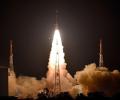
"I am really grateful to the entire ISRO family for having worked this hard and making IRNSS-1I a success," said the space centre's chief K Sivan.

On Friday, July 14, India launched its ambitious third lunar mission Chandrayaan 3, eyeing a rare feat in moon exploration.

On Sunday, July 30, 2023, the Indian Space Research Organisation successfully launched its proven Polar Satellite Launch Vehicle rocket carrying seven Singapore satellites from the Satish Dhawan Space Centre in Sriharikota and placed them into intended orbits.


India is all set to script history by launching a record number of 22 satellites, including a number of micro and nano ones from foreign countries, in a single mission in May this year.
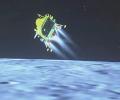
After Chandrayaan-3 touched down on the Moon, the Congress on Wednesday said it is a collective success of every Indian and ISRO's achievement reflects a saga of continuity and is truly fantastic.

"I am extremely happy to announce that GSLV Mark III successfully injected Chandrayaan 2 in the defined orbit, infact the orbit is 6,000 km more than what was intended," Sivan said.
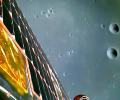
Taking to X (formerly Twitter), ISRO said, "Chandrayaan-3 Mission. Chandrayaan-3 Rover to MOX, ISTRAC, Moon walk begins!"

ISRO chairman S Somanath said the success gave the space agency "greater confidence," as the GSLV will be next deployed in the NISAR mission, a collaborative effort with the US' NASA.

Other than the Cartosat-2 series satellite, the PSLV is carrying 29 nano satellites from 14 countries - Austria, Belgium, Chile, Czech Republic, Finland, France, Germany, Italy, Japan, Latvia, Lithuania, Slovakia, the United Kingdom and the United States of America besides a nano satellite from India.

Microsat-R, an imaging satellite, is meant for military purposes, but the ISRO did not give any details about it.
ISRO chief's comments came after NASA said that it had found the remains of the Vikram lander by its Lunar Reconnaissance Orbiter and credited the discovery to Chennai-based amateur astronomer and engineer Shanmuga Subramanium.
If it becomes a reality, the Chennai-based company will become the first private player from India to conduct such a mission to the lunar surface.
In a New Year gift to the nation, the Indian Space Research Organisation on Sunday successfully launched a Geosynchronous Satellite Launch Vehicle with an indigenous cryogenic engine from the spaceport of Satish Dhawan Space Centre in Sriharikota, entering a select club of nations.

The space agency launched 104 satellites, breaking the previous record of 37 by Russia.

'Today onwards, the onboard thrusters will be fired and Chandryaan-3 will be taken away from Earth for an eventful landing on Moon's surface on August 23'

Around 23 minutes after lift-off, the primary satellite got separated and it was followed by six other co-passenger satellites, which were deployed into the intended orbits sequentially, ISRO said.
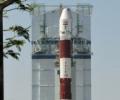
Indo-French oceanographic study satellite 'SARAL' and six foreign mini and micro spacecrafts were successfully launched on Monday by Indian Space Research Organisation's PSLV-C20 rocket from this spaceport.

Except Pakistan, seven SAARC countries are a part of the project.

The ISRO is strengthening 'eye in the sky', which helped the Indian army carry out surgical strikes last year, with the launch.

The successful orbiting of the satellites by the Polar Satellite Launch Vehicle PSLV C-40 comes four months after the Indian space Research Organisation's mission to launch backup navigation spacecraft IRNSS-1H onboard PSLV-39 ended in a rare failure.

The rocket is almost 49 meters high -- as much as a 17-floor building. It weighs 415 tons -- as much as the combined weight of 80 full grown elephants.
Despite the chill in bilateral ties, Pakistan's media on Thursday gave front-page coverage to India's historic moon landing while a former minister even called it a 'great moment' for Indian Space Research Organisation.

The feat is the second one for the Indian Space Research Organisation scientists in using the indigenously made cryogenic stage after the January 5, 2014 launch of GSLV-D5.
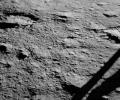
The lessons learned from the failure of Chandrayaan-2 contributed to the success of India's third lunar mission, former space scientist with the Indian Space Research Organisation (ISRO) Nambi Narayanan said, after the successful touchdown of the 'Vikram' lander on the lunar South Pole.

The first Trajectory Correction Manoeuvre of India's maiden mission to Mars was on Wednesday carried out successfully by Indian Space Research Organisation scientists on the spacecraft, which is presently travelling some 2.9 million km away from Earth.

'When a Project Director is appointed, the whole organization -- including the Chairman ISRO -- works for his success. It is a lesson that has been of abiding value all through the other projects I have worked on,' recalls the late President, one of the earliest pioneers at ISRO.

The satellite would provide a thrust to mobile communication through multi-beam coverage facility, the ISRO said.
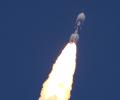
India's first solar mission, if successful, will showcase ISRO's ability to explore the cosmos, explains Kumar Abishek.

The Indian space agency has already begun work on the third generation of the earth observation satellite -- the first of which will be ready by 2018 and boost the capability to generate digital maps.

The first 'Pad Abort Test' demonstrated the safe recovery of the crew module in case of any exigency at the launch pad, the Indian Space Research Organisation said in a release.
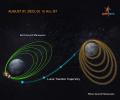
The Propulsion Module (PM) of Chandrayaan-3 has been moved from an orbit around the Moon to an orbit around Earth, the Indian Space Research Organisation (ISRO) has said, terming the operation a unique experiment.
While the historic success of Chandrayaan-3 is celebrated by Indians across the world, two untrumpeted engineering colleges in Kerala are basking in the glory of the key role played by some of their alumni in the crucial Moon mission.

Former National Aeronautics and Space Administration (NASA) Official Mike Gold has said Chandrayaan-3's success is a triumph of Indian innovation, human capital and the capabilities that will take India even further.

The primary goal of HysIS, whose mission life is five years, is to study the earth's surface in visible near infrared and shortwave infrared regions of the electromagnetic spectrum.

Aditya-L1 is the first Indian space-based observatory that will study the Sun from a halo orbit around the first Sun-Earth Lagrangian point (L1), which is located roughly 1.5 million km from the Earth.

'ISRO's style is a terrific example of being able to survive, acknowledge failures, and then most importantly of all, learn from them to ensure that subsequent missions are successful.'

It also carries equipment for meteorological data relay and satellite based search and rescue services being provided by earlier INSAT satellites.
